This blog will chronicle my medical volunteer work with Village Health Works in Burundi.

Sunday, September 8, 2013

A Busy Monday


Monday is always a busy clinic day. That’s because we don’t have a formal clinic on the weekends, although there are always a few patients who show up on Saturdays and Sundays. Often, these are very ill patients who cannot wait for Monday. That is certainly the case with the children that I see on the weekends.
So Mondays are generally the busiest days of the week, but this past Monday was beyond anything I had ever experienced. There were over 200 patients who came to the clinic that day. Those patients were ultimately seen by one of the four doctors, myself included. While I am here, I am assigned to see all the children who come to the clinic that day. I saw 44 children that Monday. Some of my patients waited over 8 hours to be seen, yet there were no complaints. They accepted their fate with a stoicism and an equanimity that is at the core being of the people of this country.  
I show you below two pictures of the patients, as they assembled that day on the terrace of the community center. Those pictures give you some idea of the numbers of patients that day.
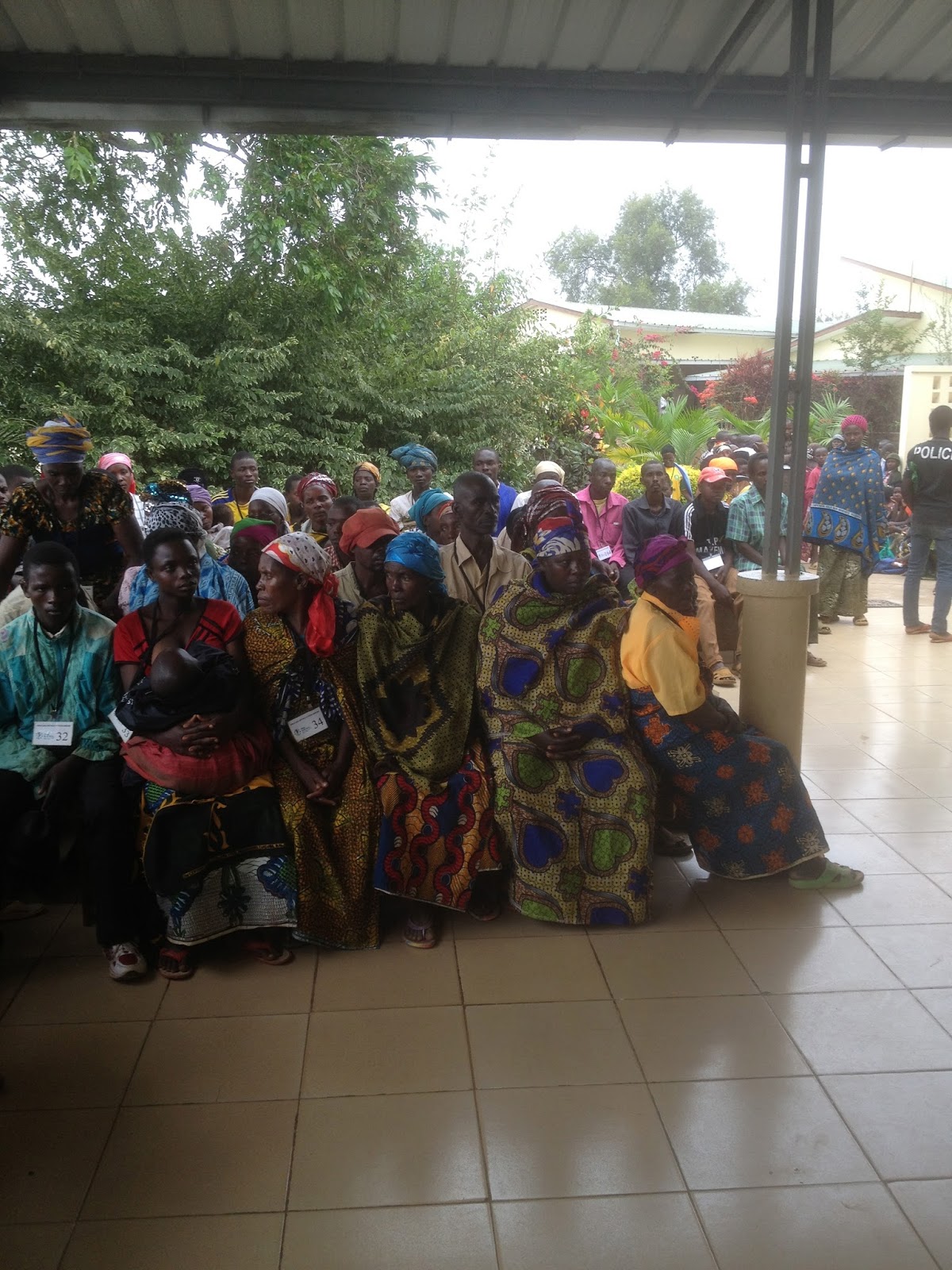


To give you an even better idea how many patients there were that day, I show you below two pictures of the clinic corridor outside the doctors’ offices. These pictures were taken at 4 P.M., and all of the patients that you see were still waiting to be seen.


The way the clinic works is that the patients line up early in the morning behind the clinic gate. The gate opens at about 7:30 A.M., and they all stream in. The patients are given badges with numbers coinciding with the number that they are in the line. All the patients assemble on the terrace in front of the community center, and the nurses then do vitals on all of the patients.
     There is no formal triage system here, because they simply don’t have the personnel to do so. Therefore, I make it a point to do my own version of triage. I walk through the crowd of patients in order to see if there are any children that need to be seen before the others. That Monday, I came upon one such patient immediately.
     His name is Methode Tyihimibaze, and he is a ten year old boy. He was sitting in what passes for a wheelchair here. He looked up at me with large, dark, scared, uncomprehending eyes. I instantly knew why. He could not breathe. His chest was barely moving, as he struggled to get air into his alarmingly thin, muscular body. I listened to his chest, and there was almost no air exchange in his lungs. What I did hear was the unmistakable “whoosh” of a loud and continuous heart murmur. I also perceived a faint, high-pitched scratchy noise.  
My first thought was that this was another case of rheumatic heart disease with associated heart failure. My second thought was that the faint scratchy noise was the sound of pericarditis; that this boy had so much fluid around his heart that his heart could not pump effectively. That was why he could not get any air into his lungs. If he did indeed have pericarditis, we were dealing with a life-threatening condition. I asked Dr. Cyriaque to listen to the boy, and he confirmed my suspicions; that this boy might well have acute pericarditis.
We wheeled the boy into my office, which also serves as my examining room. There is a desk in the office, a chair for me, and two chairs in front of the desk. The patient sits with the child in one of the chairs, and my interpreter sits in the other. I use the interpreter’s chair when I examine the patient, or, if the patient is old enough, he or she sits on the examining table. Two large windows in my office look out into the fields and trees around the clinic.
The other three doctors were in my office with me. It was a given that we would all work together on this patient. The situation was too critical; a child’s life was at stake. We carried Methode to the examining table; he did not have the strength to move from the wheelchair. His eyes betrayed only fear and pain. He said nothing, nor did he even utter a sound while we worked on him.
We put a pulse oximeter on his finger, and the reading varied between the low 80’s and high 70’s. We wanted to give him oxygen, but the only two oxygen cannisters in the clinic were being used by other patients.
We needed to know if he had pericarditis. The clinic has a portable ultrasound machine. It is not the most sophisticated of ultrasound machines, but it serves its purpose. Dr. Zenon used the machine to perform an echo on Methode’s heart. There was no evidence of fluid around the heart; therefore, he did not have pericarditis. The cardiac valves looked relatively normal. However, the heart itself was markedly enlarged, and its contractility significantly diminished. Methode had a damaged heart; a heart whose function was seriously compromised. We did not know why or how it got that way.
There was more to Methode than a bad heart. I listened again to his lungs, and he was barely moving enough air to hear any sounds. Yet I perceived this time the almost imperceptible, but unmistakable sounds of wheezing. I had not heard it initially, possibly because his heart murmur had drowned out the nearly silent wheezing. The only logical conclusion now was that Methode had severe asthma in addition to his heart disease.  
 We put him on continuous inhaled Albuterol via a nebulizer over the next two hours. This was Albuterol that I had brought from home; Albuterol that had been generously provided by the WestVal pharmacy in our building; Albuterol that is unavailable in Burundi; and, finally, Albuterol that I believe saved this ten year old boy’s life that Monday morning. 
We also gave him a strong dose of steroids via an I.V. We gave him Lasix to reduce the fluid overload that had accumulated form his heart disease. Methode’s breathing gradually improved over the next two hours. His oxygen level increased to the high 80’s and even low 90’s. We were able to free up one of the oxygen dispensers to use on him. I would not say he was comfortable, but, at least, I could hear air moving in and out of his lungs.
Methode has continued to improve over the last five days. He now appears comfortable, and his lungs are almost clear. As proof of his improvement, I show you a smiling Methode from this afternoon.


We will discharge Methode from the hospital this week. His asthma has been successfully treated for now. What will happen if another asthma attack occurs, which it is certain to do? I am not optimistic. The family comes from faraway. It is unlikely that they will have access to the kind of medical care and medications that they received here. One can only hope that he recovers from future asthma attacks. But, more importantly, what can we do about the more important problem: his heart disease? I leave that discussion to the next blog post.


Wednesday, September 4, 2013

A very sick child


     A two year old boy was carried into the clinic on Friday morning. He was in what is called “status epilepticus,” meaning that he was in a continual state of seizure activity. The story is as follows: this 2 year old boy had been, according to the mother, a completely normal two year old boy until three days prior to his arrival in the clinic. He did all the things that any two year old boy does: walk, run, jump, talk, and, presumably, get into trouble. It was at that point that the mother reported that he developed increasing weakness. The weakness progressed to the point where he could no longer walk, or even sit.
     The child started to have seizures at some point early on the morning he was brought into the clinic. The seizures continued uninterrupted over the next two hours, maybe even three hours. It took the mother that long to get to the clinic. I am not sure how she got here; perhaps she carried her seizing child up the mountain; perhaps she had some form of transportation that got her part of the way here. All I know is that her seizing child remained in her arms the entire time he continued to seize.
     The child arrived in my office late in the morning on Friday. He was unresponsive, and still seizing. The seizure involved primarily the left side of his body, but did extend to his right hand. This is what is called a focal seizure, and often has a worse prognosis than generalized seizures. I cannot explain why his seizures were focal. Perhaps I could explain it if I had access to any of the modern diagnostic modalities that are available at any hospital in the United States, modalities like CT scans or MRI’s. However, there is only one CT scan in the entire country and it is in Bujumbura, and there are no MRI’s.
     We immediately gave the child an intramuscular dose of Diazepam. The seizures stopped very quickly after the Diazepam was given, but the child remained unresponsive. I was able to then examine the child. I was struck by his marked pallor: his nailbeds were chalk-white, as were his conjunctiva (the lining of the eyes and eyelids). His spleen and liver were significantly enlarged. Surprisingly, he did not have a fever.
     We were not sure what exactly was wrong with the child, but our first thought was malaria, despite the absence of fever. In fact, malaria is generally the first, second, and third thoughts in these situations, when you have a critically ill child like this. We did a quick test to document the presence of malaria, and it was instantly positive. I also did a blood test to confirm the anemia. His hemoglobin was 3.7, which meant that he was profoundly anemic. The anemia was caused by acute hemolysis (breakdown) of red blood cells, secondary to the malaria parasite.
      We gave the child twice the usual dose of quinine, because that is the protocol when a patient has severe, life-threatening malaria. We also gave him a high dose of Ceftriaxone, because of the possibility of secondary infection, like pneumonia or even meningitis.
     The child was in dire need of a transfusion. We now have the ability to do transfusions at the clinic. We have not had that ability prior to this year. However, this child had blood type B+, and we did not have any B+ blood. The nearest center that did have B+ blood was at least an hour away in a town called Bururi. The lab tech went down the mountain in the truck to get the blood. I did not expect him back for at least four hours, so I was pleasantly surprised when he returned in three hours. The child was subsequently transfused. We put him on our limited supply of oxygen prior to and after the transfusion.
     It appeared that we had stabilized the child. His breathing, which initially had been rapid and labored, slowed over the next 24 hours. It was not normal, but he showed less evidence of respiratory distress. However, his level of consciousness remained unchanged. He did not open his eyes; he did not respond, except perhaps to deep pain.
     It was approximately 36 hours after he was admitted that the child’s breathing once again became labored and irregular. We increased his oxygen intake; we tried everything we could. It was all to no avail. The child died very soon after his breathing had worsened.
     I do not know exactly the ultimate cause of his death at the end. I do not know why he had such a prolonged seizure. I do not know why the seizure was focal, rather than generalized. I can only surmise about these issues. What I do know for a fact is that malaria killed this child.
I know the numbers about malaria: somewhere between five hundred and six hundred thousand children die in Africa from malaria every year. A child in Africa dies every minute from malaria.
     The statistics are almost inconceivable. What is not inconceivable is to be the doctor who could not prevent a child’s death from malaria. What is not inconceivable is to see first hand a previously healthy two year old child die in his mother’s arms from malaria.
I know now all too well the destructive power of this disease, so ubiquitous here in Africa. But knowing it and seeing it in all of its unmitigated force are two different things. I saw it Saturday night, and I will presumably see it again for I intend to keep coming back here year after year. I can only hope that the scourge of malaria will somehow be lessened at some point here in Africa. I know that malaria will never be eradicated, but perhaps it is reasonable to hope that one day, we will have a lessening of the devastation that it wreaks on the children of Africa.

Sunday, September 1, 2013

The One Month Old Baby

       It is rare for a patient to come to the clinic at night. The walk up the mountain is difficult enough during the day, and even more foreboding at night. The same is true for the steep and treacherous mountain paths that connect to the clinic. That is why, when a patient does come to the clinic at night, it is because he is in dire need of medical care. This is particularly the case when the patient in question is a child. I tell you this as a backdrop to last night’s events.
     Last night at about 9:30 P.M., a mother arrived at the clinic with her one month old baby. The baby had developed a high fever three days ago. He had ceased eating. The day after he developed the fever, he started having seizures. During one of the seizures, the grandmother performed scarification over the baby’s lower chest. Scarification consists of making shallow incisions in the skin, generally with a razor or knife. The baby bled, but not profusely, and the bleeding was minor. However, the scarification was considered a success, because the baby did bleed. The seizures ultimately stopped.
The baby showed no improvement over the next 24 hours: the high fever persisted, and the baby took nothing by mouth. The mother then brought the baby to the local “Centre de Sante” (Health Center). These “Centres de Sante” are tiny offices which are found in almost any village in Burundi. They are staffed not by doctors, but by nurses who possess little medical expertise. The centers are ill-equipped, rarely possessing even the most rudimentary medical equipment, such as stethoscopes or thermometers. I refer to them as “Centre de Mort” (Death Center).
The mother of the one month old baby had no other choice but to take him to the Centre de Sante. She had no other access to medical care. The nurse at the center did not examine the baby. He merely asked the mother what was the problem, and then sent her home with Tylenol for the baby.
The baby was unchanged over the next 24 hours; he did not eat and continued to have high fever. The mother was then able to take the baby the next morning to the large provincial hospital in Rumonge. This is one of the major medical centers in Burundi. However, the baby was not even given a cursory exam at the hospital. Instead, the nurse, upon hearing the story, told the mother that they could nothing for her there at Rumonge, and that the mother’s only hope was to take the baby to our clinic in Kigutu.
I do not know the details, but I do know that, over the course of the day, the family was able to get access to a car. They made the one hour drive up the mountain to the clinic last night.
I was summoned along with the other weekend doctor, Dr. Remy, to see this one month old baby at about 9:15 P.M. One look told me that there was virtually no hope. The baby showed obvious signs of meningitis and sepsis. His anterior fontanel (“soft spot”) was bulging; his breathing was irregular, almost to the point of being agonal; his extremities were cold and clammy; he was profoundly anemic, as was evident by his extreme pallor. He was comatose, responding only to the most painful stimuli. His pupils were dilated, and responded sluggishly, if at all, to a bright light.
There were four of us in that room: myself, Dr. Remy, and two nurses. We did everything in our power to save that baby. He was so dehydrated that we could not find a vein, but we were still able to give him injections of three antibiotics: Ampicillin, Gentamicin, and Ceftriaxone. We gave him an injection of steroids to lessen the swelling in his brain. We put him on the limited supply of oxygen that the clinic possesses. We worked on him for over two hours, and stabilized him enough to get him to the ward. However, within 20 minutes of arriving on the ward, he died. I was with him when he died, and I watched while his breathing ceased. His heart slowed and very soon, there was no detectable heartbeat. He died in his mother’s arms at about 11:30 P.M.
Our cause was hopeless from the beginning. There was nothing that we could have done to reverse the cascade of events that led to his death. But was it too late two days ago when he went to the “Centre de Sante?” Was it even too late when he went earlier in the day to the hospital at Rumonge? Yes, it probably was, but we will never know for certain. But whether it was or wasn’t, it does not excuse the callous disregard for human life shown at the “Centre de Sante” and at the hospital at Rumonge. I know where I am. I know that I am in Burundi. I accept the medical limitations imposed by working here. I accept that I can only do so much for my patients. I accept what I have and what I do not have at my disposal. What I cannot accept and will never accept is indifference and irresponsibility from any person in the medical field. It is incumbent upon all of us who do this for a living, whether it is the lowliest nurse or the most sophisticated doctor, to do what we can for our patients. Shame on those who don’t; shame on the “Centre de Sante” and shame on the hospital in Rumonge for dereliction of their duty. 

Year Four Begins


It has been many months since all of you have heard from me; many months since you have shared in my experiences at the clinic in remote Burundi. I have now returned to that clinic after a fifteen month absence. This will be my fourth year at the clinic, and, based on my first two days, I expect it to be no different than any previous year.
It’s not as if I forgot the extent and the degree of pathology one sees at the clinic. One can never forget. Yet, seeing it once again in all of its presentations is still shocking; not surprising, but shocking.
     I need only be reminded of that pathology by the clinic’s malnutrition ward. The ward is more than filled to capacity, as there are presently 14 patients on the ward, but only twelve beds. That’s because two of the beds are occupied by two sets of twins. You see below a picture of the malnutrition ward. The picture does not show you the entire ward, but it does give you an idea of what the ward looks like.


      The most dramatic of these twins were two girls, now almost six months of age. They each weighed 5 lb. at birth, and at 5 months of age, they each weighed 6 lb. That’s right: the twins have gained exactly one pound in the first 5 months of life. The mother attempted to breast-feed them, and she is still breast-feeding them. However, she realized at some point that her twins were not getting enough milk. Therefore, she decided to supplement them. Formula is not an option here, so, instead, she made a Burundian staple called “bouillie.” It is a sort of rudimentary Burundian porridge: not exactly the kind of stuff you want to feed your infant daughters. The bouillie did nothing to correct the situation.
     The twins came into the clinic severely malnourished. That was almost a month ago, when they were five months old. There is a standard UNICEF protocol for the treatment of malnutrition, but that protocol is designed for infants greater than 6 months of age. We at the clinic modified the protocol for the twins, and, because of that modified protocol, they are doing better. The problem will come when they go home. What will happen then? Are they not destined to return here when their severe malnutrition resurfaces? The answer is somewhere between “perhaps and probably.” It’s not as if the mother’s milk supply will magically increase. We will send them home with some Plumpy-nut, the nutritional peanut paste that is the standard nutritional supplement given to all the malnourished children. Once that Plumpy-nut supply is exhausted, the plan is to give them regular milk; not the ideal alternative for a six month old, but significantly better than the “bouillie” they were getting. I show you here a picture of the now 6 month old twins, as they are today.


     Then there is a three month old on the ward who is also a victim of inadequate breast milk production. He has not gained any weight in those three months, and remains at his birth weight. He too is on the modified UNICEF protocol, and is doing better. Again, the problem will arise when we send him home, as we inevitably must do. The only hope is that the mother’s milk production will increase when he goes home.
     There are also a variety of older children, including this five year old who has all the signs of Kwashiokor (protein deficiency) malnutrition: the swollen face and legs, the expressionless look of complete apathy on his face. He will get better, but it will take time. This is the boy, two days after admission to the hospital.


     This is my fourth year at the clinic. I now have four years of perspective. Do I see any improvement in those four years in the problem of malnutrition in Burundi? I don’t think so. The malnutrition ward continues to be filled to capacity, and often beyond capacity. I see many children in clinic ever day, and the vast majority of those children are malnourished to some degree, some severe enough to be hospitalized. 
     I know that there are experts, including dedicated agronomists, working on the problem of malnutrition in Burundi. I wish I could say that their efforts have been successful, but I can’t. I will be coming back here for many years. Perhaps in the years to come, I will see an improvement in the malnutrition situation. One can only hope so. Seeing one severely malnourished child is one too many. Seeing many, as I have and as I do, is an obscenity.
     Before I leave you, I show you two unrelated pictures. The first is simply a cute, little boy who is the sibling of a patient in the hospital. The second is a mother taking home her newborn baby, wrapped in the traditional Burundian way. The baby is only four hours old, but that is the usual amount of time the mothers spend at the clinic after giving birth.