This blog will chronicle my medical volunteer work with Village Health Works in Burundi.

Monday, June 4, 2012

Day 1 (continued)


We were still on Day 1 at the clinic when I temporarily interrupted my account to publish my most recent blog post. Now back to that first day. We continued on our rounds uneventfully until we came to the malnutrition ward. I will remind all of you, both new and old to my blog, that we have, here at the clinic, an entire ward devoted to the treatment of severe malnutrition. I am not referring to the type of malnutrition that is a fact of daily life in Burundi; I am referring, rather, to the life-threatening malnutrition that is all too common here in Burundi; malnutrition which dehumanizes the child afflicted with it; malnutrition which is an omnipresent blight on the world in which we live; malnutrition which is always shocking in its appearance; malnutrition which we should be ashamed that it still exists on such a global scale. But it does exist, and the patients that this clinic serves are fortunate that our malnutrition ward is there to serve them. That ward is the only one of its kind in Burundi, and one of the few in all of East Africa. It is a given that there is a need for many more such wards, but it is an equal given that socio-economic conditions prevent their existence.
The VHW malnutrition ward can theoretically accommodate as many as twelve patients. I say “theoretically”, because, if conditions demand, the ward can accommodate more patients. Conditions often do demand exactly that. I have only been here one week, and I have already admitted ten patients to the malnutrition ward. Those ten patients will stay on the ward an average of 7-10 days. It is only after those 7-10 days that they can safely be sent home. It is easy to understand why the ward is almost always full, and sometimes, more than full.
The patients on the malnutrition ward that first morning were in varying stages of treatment. I show you one of them.

This is a nine year old girl who weighs 12 kilos (about 26 pounds). She has acute malnutrition grafted onto chronic malnutrition. That is why she is so small. You can see her face, swollen with the edema typical of the Kwashiokor type of malnutrition. This girl is not your typical malnutrition patient, for she has other, serious medical problems. She has been admitted four times in the past 15 months for severe malnutrition. Her liver is significantly enlarged; she is profoundly anemic with a hemoglobin of 5; she has an elevated white blood cell count; she is moderately jaundiced with an elevated bilirubin; and she has had a prolonged fever. She actually looks better than those laboratory numbers would indicate. We don’t know what’s wrong with her. We have limited diagnostic modalities here. She will ultimately go home without a diagnosis. My thought is that she may have sickle cell disease, but we do not have the means to know that for certain. She will probably be back, if only, once again, to treat her malnutrition. Perhaps then we will make a diagnosis, but I doubt it.
My clinic day began immediately after hospital rounds. I knew even before I started seeing patients that it would be a busy day. Patients were streaming into the clinic en masse as we made our rounds. I could see that many of those patients were children, most of whom were strapped to their mother’s back, African style.
There were a number of routine patients that day, at least routine by Burundian standards: pneumonia, abdominal pain, diarrhea, scabies, secondarily infected scabies, fungal infections, to name a few. Those were patients I sent home. There were also a number of patients that I did not send home nor could not send home. These were patients that I admitted to the hospital. Some of those patients were routine admissions by Burundian standards, some were not. I give you all of those admissions, routine or not.

The first was a two month old boy who was brought into my office on his mother’s back. She removed him from her back and, at my request, unwrapped him. That was when I got my first look at him. It was not a reassuring look. He was clearly in severe respiratory distress. His respiratory rate was 70-80 times per minute, and his little stomach muscles were caving in and out with each rapid breath. He had a fever of 39.3. I listened to his chest, and heard sounds consistent with both pneumonia and bronchiolitis. It did not matter which it was, because he would be treated for both.
I checked his oxygen level with our pulse oximeter, and it varied between the high 70’s and low 80’s. This was a patient who, if he were in the United States, would have been admitted to the ICU. Needless to say, we do not have an ICU. We have a regular ward for sick children. It was, like the rest of the hospital, a ward with limited therapeutic resources. Among those limited resources were nebulizers for the treatment of asthma and bronchiolitis. What was not among those resources were the medications, like Albuterol, that go in the nebulizers. They had run out, and had been unable to get more. This is a sad commentary on the way of the medical world: we at home who have so much, they here who have so little. Fortunately, I had brought a supply of Albuterol nebulized solution.
It is said that the younger the child with bronchiolitis, the less likely that bronchodilators were to make a difference. I can tell you with certainty that the nebulized Albuterol did make a difference for my two month old. I cannot say that the child would have died if I had not arrived in Kigutu with my supply of Albuterol. I know that children here are remarkably resilient. However, I can say that the child is better now, and I believe that the Albuterol is partially responsible for that improvement. Yes, the broad spectrum antibiotic, Ceftriaxone, helped, but I have my doubts as to whether he would have survived without the Albuterol.
There was another element of treatment for this child that we take for granted in the United States. It is an element called oxygen. Every hospital, every clinic in the United States has an unlimited supply of oxygen. The clinic here has an all-too-limited supply of oxygen. My two month old did get some of that all-too-limited supply, but only on an intermittent basis, and only when he desperately needed it.
This two month old is still in the hospital, five days after I admitted him. He continues to breathe fast, and continues to show increased effort to breathe. But he is markedly improved from those first two days he was in the hospital. I am confident that we will be able to send him home relatively soon.
Now to the next two patients, both of whom were admitted for severe malnutrition. I have by now seen hundreds of cases of malnutrition. Yet my familiarity with malnutrition will never inure me nor should it inure me to the sight of another severely malnourished child. To see these children is always a shock, for these are children who are lifeless; children who are devoid of animation; children whose eyes are expressionless. They react little, if at all to their environment. Then there are the physical signs: the pencil thin arms and legs, and the often swollen faces and abdomens. I admitted two such children that morning.
     The first was a nine month old who weighed 4 kilos (a little less than nine pounds). This child's story was different, but no better than the usual one. Her mother had been unable to breast-feed her from birth. Apparently she did not have enough milk. So, instead of breast milk, she gave the baby water with sugar, and, later, regular milk whenever she could get it. The grandmother had seen enough by the time the baby was four months old. That’s when she decided to take matters into her own hands, or more precisely, into her own breasts. She herself decided to breast feed the baby. The only thing working against her was that she was 54 years old by then, and her youngest child was 13 years old. But breast feed she did. I am witness to it. The baby did not seem to care to what breast he attached himself, and he attached himself quite happily to his grandmother’s breast. I cannot imagine he got that much, because I had to admit him for malnutrition. However, he must have received something from the grandmother. If not, he would presumably have not survived even to that point.
     The second patient was a three year old boy who weighed 8 kilos (about 17½ pounds). He had the typical malnourished appearance: the abdomen swollen with fluid; the wasted extremities; and, perhaps most obvious, the vacant look so typical of severe malnutrition. You can see that look in his picture below.


     That was half of my first clinic day. The rest remains to be told. However, before I leave you again, I prefer to leave with some uplifting pictures, some feel-good pictures. The first is the positive end result that we generally get when we admit a child to the malnutrition unit. This is a child who presented in the same way as every other child I have admitted to the unit: with that same ennui and lack of life force so typical of malnutrition. You see her at the end of her treatment: a playful, happy, little girl. She seems to have visions of becoming a doctor, because, in the second picture, the papers she carries in her hands are her hospital chart. I suppose she thought she was making rounds with us.


These latter pictures I post are scenes from life in Kigutu. You will see these pictures and you will immediately know why I am here, and why I will continue to come here every year. The children are so beautiful, and so happy, yet they have nothing. These pictures speak far more than any ten thousand words I could possibly say.


And, finally, the doctor and the dancing girls:

Thursday, May 31, 2012

Back in Kigutu


I have arrived here at the clinic. It is, for me, a coming home again; a coming home to a place that will always be special to me; a place that is now a constant in my life. I was nearly brought to tears tonight as I sat there at the communal dinner, with all of my friends and colleagues around me, eating our usual dinner of rice and beans, with Melino's African music playing, and the beautiful African star-lit sky around us, breathing that soft African air. All of us there for a common purpose, and I share in that purpose. I am, as I keep saying, the lucky one, that I can do this; that I can be but a small part of this selfless endeavor. I cannot imagine not doing it. I know my time here is limited, and I would not, nor could not have it any other way. But I love it here, for it brings a certain meaning and joy to my life that I could not have elsewhere.
 There have been significant changes in the clinic since last year; “changes” meaning modernization of the clinic. There are now three separate wards: one for men, one for women and children, and a third one for malnutrition (some of the sick, non-malnourished children are housed in this latter ward). Previously, there were only two wards: the first was for men and women together; the second for the malnourished children. The sick, but not malnourished children, were divided between the two wards.
There are new tile floors in each ward, as opposed to the dusty and dirty, old concrete floors. There is more space between the beds, although the wards would still seem impossibly crowded by American hospital standards. The overall effect is that the clinic seems cleaner and more sanitary.
This is my third year at the clinic, and I know that the cliché of “expect the unexpected” is a truism here in Kigutu. But my first working day back at the clinic was far more than unexpected. It was my medical version of what Alice must have experienced when she walked through that famous looking glass into her wonderland.
The day started out innocently enough, as the team of doctors and nurses started our hospital rounds with the usual suspects: the diabetics with their diabetes out of control. We can regulate the diabetics’ blood sugars in the hospital with the use of insulin. The problem comes when those diabetics go home. They vast majority of them cannot afford the cost of the insulin. We can give them a short supply, but once that supply is exhausted, they are left where they started: blood sugar again out of control. Moreover, most of our population can neither read nor write, nor do they know numbers either. That makes it impossible for them to administer the appropriate dose of insulin.
We, therefore, try to transition these diabetic patients to an oral glycemic agent, like Metformin, before we send them home. The process of effecting that transition takes days, if not weeks. That is why we have at least three or four diabetics in the hospital at any given time.
We eventually finished rounding on the diabetic patients. It was then that my “looking glass” day began. The next patient was a sixteen year old boy, with a history of epilepsy. He had been on the ward three months. His story goes as follows: he had a seizure at home, during which, as a result of the seizure, he fell into a fire. However, no one would rescue him from the fire while he was having the seizure. The reason? Because it is a commonly accepted belief here that, if one touches someone who is having a seizure, one will then develop epilepsy; that epilepsy is passed on exactly in this way; that it is contagious by contact with a patient in the midst of a seizure. But, wait, there is more to the story: if the person having the convulsion passes gas (aka, farts) during the convulsion, one will then develop epilepsy as a result of inhaling that gas. That is why people stand far back when someone is having a seizure.
This Burundian folk belief was confirmed by another, and completely independent source. One of my clinic patients today was a sixteen month old boy who has a previously untreated seizure disorder. The child has had multiple seizures, and I questioned the mother as to what she does when her son has a seizure. She said that she never touches him during the seizure, but, instead, stands several feet away.
There is more to the story of the 16 year old boy with the seizure. His seizure, as all seizures eventually do, stopped. It was only then that he was pulled out of the fire. It goes without saying that he suffered severe burns. The only good news is that the burns were confined to the lower half of his body. He was then taken to the traditional healer (mupfumu) for the treatment of his burns, rather than being brought to the hospital. Herbal remedies were applied to the burns for two weeks. The burns became increasingly infected, to the point that his entire legs were one coalescent abscess. It was at that belated point that his family carried him into the clinic. He could not walk by then. Appropriate and aggressive treatment was begun immediately with high doses of antibiotics and frequent dressing changes.
It is to the credit of the doctors and the nurses here that the results are as good as they are. The fact that it is three months since he was first admitted to the clinic gives you an idea how severely infected the burns were when he was first admitted. The boy would have died if his family had waited any longer to bring him to the clinic.
Perhaps you can get some idea of the extent of his burns when you see this picture taken of him, three months after admission to the hospital.

 The story of the epileptic boy and his burns is indicative of the strength of cultural beliefs here. It is unfortunate that these beliefs are often so damaging and dangerous.
I saw again today the power of these beliefs. A six month old child was brought into the clinic this afternoon. He was close to death. He had high fever, and, more importantly, had been suffering from what must have been severe diarrhea for a week. He was as dehydrated as any child I have ever seen. He was a limp rag, barely aware of his surroundings. He made no eye contact, and did not move as I examined him. One of the reasons for his profound dehydration was that his mother had given him an “enema with traditional herbal medication.” Her thinking was that the enema would, in her words, “relax his stomach;” not exactly the right approach when your six month old has profuse, watery diarrhea. 
Here is a picture of the child prior to his fluid resuscitation. 

I will, however, reassure you that the child will almost certainly recover. Maneno, one of our most expert nurses and a magician at getting I.V.’s into tiny veins, got an I.V. into this particular child. The child is now receiving the large amounts of I.V. fluid needed to correct his dehydration. You will be even more reassured to know that I just saw the child. It is now approximately three hours post-admission, and the child is significantly improved. He is moving again, and is far more reactive and responsive. I have every reason he will ultimately be fine. Hopefully, the next time he gets diarrhea, the mother will not give him an enema with traditional herbal medications.  
I break off here my tale of my first workday at the clinic. I do so because there is so much more to tell about that first day, so much that will require further blog postings. I will get to those future postings, but first I want all of you who read this blog to once again get a flavor of “my home away from home.” I leave you with two pictures, the first, taken from the hill overlooking the clinic, of sunset over Lake Tanganyika.

And, finally, to get the human element at the clinic, a picture of a family of three children enjoying the little toys that I brought from home.

Tuesday, May 22, 2012

May 21, 2012: The African Adventure begins again. I will be leaving my home in Los Angeles in less than 48 hours, and returning to the now familiar surroundings of Kigutu. I will be departing Wednesday in the early A.M. for my third sojourn in Burundi. I am not a religious person;  in fact, those who know me know that I am vehemently anti-religious. But Burundi serves as my religious experience. Kigutu is my mecca. This trip has become my annual pilgrimage, my hegira to escape the modern world that I normally inhabit.

Why do I go? I go because I have to go. I go because I cannot imagine not going. I go because my time in Kigutu fulfills both personal and professional needs for me. I go because this trip provides a necessary respite from my routine here. I go because I  love the work. I go because I love the people of this small, landlocked, impoverished nation. I go because I love the children of this small, landlocked, impoverished country. I go because of the indomitable spirit that is so much a part of the people of Burundi. I go because I love the doctors and nurses with whom I work. I count many of those nurses and doctors as my friends now, and number one of those friends would be the gentle giant, Dr. Melino. I go because, once again, I will work with Dr. Melino: a role model for all of my fellow physicians. I go because, in the midst of the hard work we do, we have time to have fun, to laugh, and to enjoy life. I go because Kigutu is a sea of tranquility in the maelstrom that is my life outside Kigutu. I go because my experience in Burundi brings me an inner peace and tranquility that I find nowhere else. I go because being there simply makes me happy, and because of the joy that I feel when I am there. I go because I have fallen in love with a continent, a continent that goes by the name of Africa. And what is it that I love about this exotic continent; this continent of extreme contrasts: the overwhelming beauty and the equally overwhelming poverty? I love the sights, the sounds, the feel, the rhythms of Africa. I love the essence of Africa, the spirit of Africa. It is a continent that draws me to it, that beckons me to come very year.

I go back to Burundi because I can go back to Burundi. I have the professional expertise and training to do meaningful work in a third world country. I count myself lucky that I can do that, for not  many people can do essentially the same work in a setting completely foreign to their normal setting.  I can  also go because my partners encourage me to go. I list them by name to give them each credit for their unflagging support in my annual journey: Drs. Marshall Goldberg, Marie Medawar, Michael Wolke, Lynn Osher, and Mary Choi. I thank them collectively and individually for their generosity of spirit in allowing me to do this every year. I know that my extended absence from the practice places an extra work-load burden on them; I owe them a debt of gratitude for taking on that extra work-load.

Finally, I go because (and only readers of my previous blog posts will understand this) the Short Tie Club (STC) needs me. The STC is at a crisis point right now, so much so that I am concerned that its mere existence is in question. This is all because of the nefarious efforts of the Long Tie Club (LTC) to poison the minds of the people against it. Their propaganda directed at the STC has fulfilled their desired aim of destroying the reputation of the STC. I return to re-establish that reputation. I believe that my presence is required in Burundi to put the STC back on solid ground. I promise that I will lead the STC out of the wilderness and back into the prominent position they once held. I further promise that I will once again make the STC the pre-eminent tie club not only in Burundi, but also anywhere in the world where ties are worn.  I must go now so that the day will come, as it once did, when, as the pictures below demonstrate, every man, woman, child, dog, and cat will, once again, be proud to wear the Short Tie.


I am eager to go to Burundi, yet there is much that I will miss over the next six weeks. I will miss my daughters, Julie and Jessica, and my son-in-law, Garth. yet I will stay in touch with all of them via our daily Skype sessions. I will miss my morning cappucino, my morning breakfast routine. I will miss my twin Bichons, the irascible Ozzie and Harry. I will miss our morning and evening walks together.

But there is something new this year, something that was not present during my previous sojourns in Burundi; something that has changed my life; as well as the lives of many others. This something is actually a someone, and her name is Violet Rees Friedrich (although she often goes by the diminutive of Vio.).  She is the daughter of the former Julie Rose Shulman, and her husband, Garth Friedrich. She is the new love of my life, as well she should be. Moreover, I can state, as a completely objective observer, that she is a beautiful baby. I will miss this child, as only a "grampy," (for that is what I am called) can miss his beloved granddaughter. I will miss seeing her and being with her over these next six weeks. I will miss watching her grow and develop and evolve over that time. I know she will be a different human being when I come back, and a cuter one too. I will miss her smiling face, and her adorable personality. I will miss my Thursday evenings with Vio. I  will miss everything about her: the now three month old Vio. Finally, I offer in evidence photographic proof that my granddaughter is indeed a beautiful baby. Here she is at three months of age. The first picture is the swimsuit edition of Vio., as she readies herself for her first swimming party. Based on this picture, I see her as a Sports Illustrated swimsuit model, circa 2032. The second picture is Vio. in her ready-for- summer outfit.


Thus I bid adieu to all of my friends and family here in the United States, as I take wing on the next installment of the adventure known as "Dr. Pete Goes To Burundi." More to come from Burundi. Far more.

Saturday, June 25, 2011

A Dedication

This will be, unlike most of my others, a short blog posting. The fact that it is short should not detract from the message and the emotion it conveys. I write this as a dedication to a woman whom I only came to know about nine days ago. She is a woman that you already know. Her name is Colusha Nyogusenga, and she is 34 years old. You met her in my recent blog post about the mupfumu and medical care in Burundi. She is the one who, against her wishes, was taken to the mupfumu for treatment of her massively enlarged abdomen. He performed multiple scarifications and prescribed a soup of herbs. It was when those mupfumu methods did not work that she came to the clinic. She came, like so many others, to be cured. We have no such magic powers for her, because she has advanced and incurable cirrhosis of the liver. Her prognosis is non-existent. She will die as a result of her disease: a disease for which she is not to blame. She did nothing to cause this. She is certainly not an alcoholic. If she were a patient in the United States, she would be on a transplant list for a new liver. She is otherwise healthy. It goes without saying that such a thing is impossible here.

We have done, over these past nine days, what we can to make Colusha more comfortable. We have treated her with our most potent antibiotics to eliminate the infection that is almost certainly brewing in her abdomen. More importantly, Melino has three times drained her abdomen of fluid. Each time that he has done so, he has removed at least five liters of turbid fluid. But these procedures are only a temporizing measure, for the fluid accumulates as quickly as it is removed.

Yet through it all, Colusha gives me a radiant smile whenever and wherever I see her, which I do on many occasions. I see her on morning rounds, and I often see her outside sitting on the steps. She likes the feeling of the sun shining on her face, for it warms her disease-ravaged body. She is weak by now, so I often have to help her back to her bed, when she gets too tired to sit. She always clasps my hands in a warm embrace when she sees me. She generally talks to me, at least a few words. She speaks to me in Kurundi, so I understand virtually nothing of what she says. Yet I respond with the few words I do know. My words probably mean nothing to her. We do not communicate in words, but I think we communicate on a different and perhaps deeper level. I believe that she knows that we are doing what we can for her, and that we do care for her. I do not think she understands that she has no hope of recovery, but I think she implicitly understands the severity of her condition.

I have often talked of the "espirit" that one sees and feels here. Perhaps I have talked of it too often. That does not stop me from talking about it again, for this is a different form of the Burundian and African "espirit." It is that form of the "espirit" that Colusha personifies. She is a human being who, except for a swollen abdomen, is skeletal in appearance. This is a woman who has virtually nothing left to her absurdly shortened life; a woman who physically is suffering the effects of a debilitating disease. Yet she still looks to the sun for warmth and comfort. She still looks directly into the camera and gives us a beautiful smile that lights up her emaciated face. It is a smile that speaks of nobility of spirit, of grace and dignity under the most trying of conditions. This is a woman who is dying, and yet she is still capable of transmitting the warmth and generosity of her soon-to-be extinguished being. This is the "espirit" that moved me when I took and ultimately saw these pictures. That is why I dedicate this blog post to her. I can think of no one who deserves it more.

Colusha will probably go home tomorrow, for her time here has come to an end. We can realistically do no more. She only awaits some form of transport to take her home. She is too weak to walk, and her home is too far. I will, as with so many of the patients here, never forget her. That lovely, shining smile, in the face of her abysmal fate, will stay with me. Her smile is, in a sense, the metaphorical smile of Burundi, a country that, like Colusha, has been beset with its own abysmal fate. The metaphorical smile of Burundi bespeaks of the grace and dignity that is this country.


Friday, June 24, 2011

Little Drummer-Man

I have served many roles during my time in Burundi. Perhaps the best known of those roles would be "le roi" (the king). This is a title I wear proudly, as well I should. What greater aspiration could one have than to be "le roi" of the Short Tie Club? It is I, and only I who carries the scepter of power in the STC. Yet that scepter of power is only part of my royal duties. I must also perform all the ceremonial duties befitting my position. It is in that dual role that I serve as "le roi." It is that same dual role that I embrace.

I cherish my role as "le roi." However, that role does not define me. I am also the muganga (doctor) here at the clinic: the muganga for the children who come to this clinic. I have also been called "mupfumu," but my medical expertise at this point does not justify that appellation. I am not yet skilled enough in the art of scarification or the cutting of the uvula and epiglottis to merit being a mupfumu.

I should have been satisfied with my roles as "le roi," muganga, and future mupfumu. I had so much. was not because there was still a role that eluded me. It was a role that I sought with all the energy that my little body possessed. I am proud to say that I have finally accomplished my goal. I have achieved what I sought to achieve. I have become the official leader of the Kigutu drummers. I am now content, for I have reached the pinnacle of my life's work.

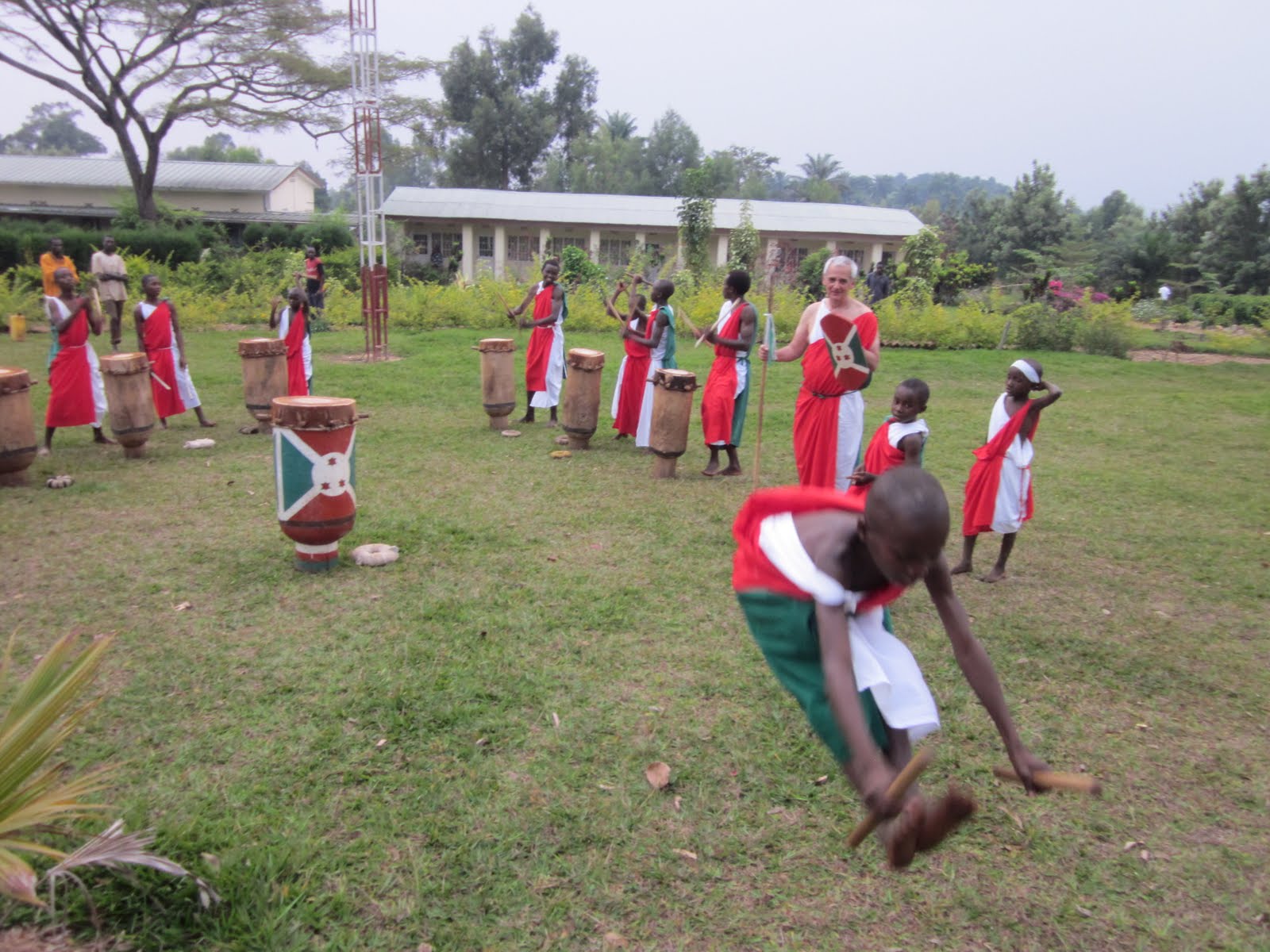
I believe that all men aspire to be the leader of an African Drum Corps. Yet so few are chosen to do so. I was the lucky one. It was two days ago that I became that leader. It was then that the Kigutu drum corps had the ceremony marking the passing of the torch from the previous leader to myself. If you don't believe me, just look at the pictures.


These first two represent my introduction as what I would call the drum major.


This next picture has great historical importance, for it is this picture that will serve as the new symbol of the Short Tie Club. In my right hand, you see that I wield the spear. It is that spear that represents our need to attack those enemies who beset us. I refer of course to the Long Tie Club. The shield, by contrast, represents our ability to protect ourselves against those same enemies. Thus, I have in my two hands the two motifs that will insure that the STC will endure: attack and protect.


The next two pictures show me leading my fellow drummers into our musical battle. The troops follow and play their drumming songs.


I was more than the carrier of the spear and the shield. As you can see, I too can be the Little Drummer-Man.


This next picture is Peter (aka Pierre), whom I have previously mentioned, showing, once again, his athletic skills.


The next two are boys demonstrating their dancing abilities, as the drummers played behind them.


Now to the truth of the matter. I was honored that the drummers did this for me. I was hoping merely to have a few photos of me in the drumming outfit. They went far beyond that. They allowed me to be part of a whole performance. I was touched more than I can say. Peter kept telling me I was doing a good job, considering it was my first time. He was being more than charitable. I know my limitations. I have no sense of rhythm. I am, if not the world's worst dancer, certainly in the top ten. If there was a television show called, "So, You Think You Cannot Dance," I would be in the winner's circle every time. Fortunately (for me anyway), I have spared you the most embarrassing photos of my performance as drum majorette. Let's just say that my body does not quite fit in with the athletic, thin, muscular bodies that belonged to my colleagues on that field. Let's also just say that if the video that Melino took of the performance ever comes to light, I will be forced to go into hiding for at least five years. I will only emerge from that hiding if I am able to change my identity. Yet, the bottom line is that I loved doing this; it was a one of the highlights of a journey to Burundi that has been filled with highlights. I thank my fellow drummers for letting me be one of them, if only for a short time.


Monday, June 20, 2011

L'espirit: Part II


I have often talked about "l'espirit" of the Burundians, as well as "l'espirit" of Kigutu, and "l'espirit" of the clinic itself. Perhaps I have talked about it so much that my message has become redundant. Rather than talking about it, I thought it would be more instructive to show it. With that end in mine, it is now picture time. A picture is theoretically worth a thousand words. Assuming that is true, this blog posting is worth about fifteen thousand of those words. I have attached no particular order to the photos, but will explain each in turn. Some of the pictures may have previously appeared on my Facebook page, but a little repetition never hurt anyone.


These first pictures were taken at the clinic today. You can see the muganga (doctor) surrounded by many children. The pictures were taken by Melino, who instructed the children to smile and wave. Most did, but, as you can see, some refused. These children are at the clinic today for a government-run program that occurs every ten months. It is a kind of Burundian vaccination clinic. However, instead of vaccinations, all the children receive a free dose of Vitamin A (their diet is woefully deficient in Vitamin A). Children less than one year receive 100,000 units, and older than one, 200,000 units. They all receive, equally free of charge, one dose of Albendazole, an anti-parasitic medication. It is assumed that all children here suffer from some sort of parasitic infestation. We don't try to figure out which one it is; we just give Albendazole for any sort of abdominal or GI complaint. The feeling is that one cannot go wrong in giving it. That's why Albendazole is probably our most commonly prescribed medication, at least in the pediatric age range.


The next pictures are the boys (with one man thrown into the equation) from Kigutu, all posing for the camera. The group grew and grew as I continued to take pictures. They all assume some sort of attitude.


The next two pictures are the Kigutu drummers in their colorful drumming uniforms. They walk and drum simultaneously, with the extremely heavy drums on their heads. This type of drumming is a Burundian tradition. The drummer in the center in the first picture is Peter, who is one of the heads of the troupe. He is also one of the essential members of the clinic staff. I am not sure exactly what he does. I do know, however, that his jobs are many, and all are integral to the effective functioning of the clinic. He is a marathon runner, and trains by running 10-15 kilometers in the hills, both morning and evening every day. He is remarkably strong and flexible, and I sincerely believe that he does not have one ounce of body fat.


The next two pictures are three adorable girls, standing outside the hut where the hospitalized patients cook their food. The cooking takes place both inside and just outside the hut. Sticks of wood are used to make the fires. If there were a Kigutu Fire Department, they might shut down the hut for not adhering to any safety standards. There are generally three or four small fires going inside the hut, and two or three outside the hut. I am convinced that some of the women who cook must have hands made out of asbestos. There is no other explanation for how they handle the burning hot wood with their bare hands. If a patient is too ill to cook for himself or herself, the food is prepared for them by those who are not so ill. That may be a friend or relative. If you want to know what they are eating, I can only tell you give you very partial information. I saw them cooking bread made out of cassava: not very nutritious, but very filling. I also saw them cook a mixture of tomatoes and carrots and onions. Everything is made in a pot over an open flame.


The next five photographs are what I call my fist-bumping series. The fist bump in Kigutu is the equivalent of the high five in the United States. It is an expression of joy and happiness. It is also an expression of a bond between the fist-bumpers. The children seem to learn it at a very young age. The first three pictures are fist-bumps with children on the malnutrition ward. These are children who have come back to life, thanks to the beneficial effects of getting enough nutrition. They are at the end of their hospital stays on the ward.


This fist-bumper is simply a cute little child outside the hospital. All you see is my hand doing the fist-bumping. You can trust that it is me, for there are no other muzungu (white person) mugangas in Kigutu.


This last one is one of my favorite patients. She is twelve years old, and her name is Divine (pronounced Di-vin-a). She has been in the hospital for at least six weeks for the treatment of a massive abscess in her back. The abscess was deep and extended all to the way up to her diaphragm. She needed it surgically drained under anesthesia, but that proved impossible, if only for financial reasons. However, we were finally able to eradicate the abscess with prolonged use of antibiotics, and, more importantly, by repeatedly opening and draining it. She will go home this week. She is a favorite on the ward. She has become my best friend. We always fist bump when I see her, and she gives me the same shy smile you see here. Her mother, who is quite large by Burundian standards, has also become my best friend. She is the one trying to teach me Kurundi.

The next three pictures are the dancing girls of Kigutu. They are wearing the uniforms that were purchased last year. The pictures give you some idea of the pure joy with which they dance. However, that joy can only be appreciated by watching them dance. It is a sight so touching that it is guaranteed to bring tears to your eyes. It may, in fact, do more than that. You may well find yourself in full crying mode, with tears streaming down your face. Perhaps it is these dancing girls, in their beautiful uniforms, who best epitomize "l'espirit" that is Kigutu. One cannot help but fall in love with this place when one sees them dance.


The last two pictures may not be representative of "l'espirit" that is the theme of this blog post. However, they are representative of the medical "espirit" that exists at the clinic. This baby was born at the clinic Saturday evening. It is the first baby for the family. The first picture was taken when she was an hour old, and the second picture the next morning. The story is as follows: the mother is the sister-in-law of one of the doctors at the clinic. His name is Remy, and he, like all of my medical colleagues, is an excellent doctor. The mother's water broke when she was at 35 weeks gestation. She was immediately admitted to the hospital for observation. She was placed on I.V. antibiotics to prevent infection. The mother is very small; she cannot not be more than 4'10", maybe 4'11" on her best day. I mention this in the context of the events that transpired.

The mother was admitted on Friday, and went into labor late Saturday afternoon. Initially things proceeded well, but the mother soon became exhausted. Her tiny body ran out of energy. It was then that her contractions stopped. We do have Pitocin at the clinic, so a Pitocin drip was started, along with I.V. fluids. Labor once again started, but it was ineffective. The baby was stuck in the birth canal. This would have been an obvious indication for a C-section at home. Such a thing is not possible here. Nor can we do a vacuum extraction. Nor do we have forceps.

There is a hospital in Rumonge where a C-section can be performed. I have seen that hospital. I have been inside that hospital. It is a snake pit, an awful place. (More about the Rumonge hospital in a future blog post) It was now almost midnight. To transport her, we would have had to place her in the back of the van, and travel an hour down a bumpy, rocky treacherous mountain road in the dark to get to Rumonge. Such a trip is difficult enough under ideal conditions, and these were far from ideal. There was legitimate concern that the baby would not survive the trip. There was equally legitimate concern that the nature of the ride itself might cause her to deliver the baby. That could have been a disaster for both mother and child.

There were no options at that point. She had to deliver the baby at the clinic. What ensued next was that Dr. Remy and two nurses pushed on the mother's abdomen, and Drs. Melino and Cyriaque tried somehow to extract the baby from below. It was only after almost two hours of perspiration-filled effort on everyone's part that success was achieved. The baby was delivered, and the baby was fine. That's where my limited role came into play. I examined the baby, and she is, indeed, perfect, weighing 2.5 kilos (about 5 1/2 pounds). I suppose that all's well that ends well. Yet I tell this story because it is symptomatic of the medical issues that the clinic faces in the vast wasteland that is medical care in Burundi. I also tell it to show you pictures of a beautiful Burundian newborn baby.